

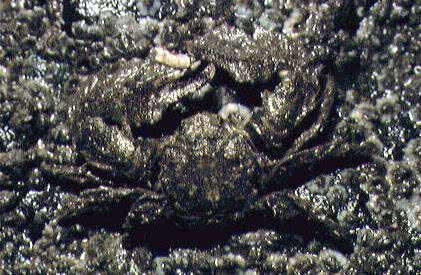
A distinctive crab although strictly, this is more related to the lobsters and squat-lobsters; they have long whip-like antennae which is not the case for the true crabs. It is a very flattened crab with sharp claws at the end of each leg. These help them grip the underside of the rocks where they live. The flattened body is a good adaptation for living under stones. Very hairy, especially along the chelae (pincers).
This crustacean group obtain the name porcelain from the texture of the exoskeleton which can be seen more clearly underneath the body. They can grip on very tightly with the claws. They feed by collecting detritus and debris in the hairs of the chelae and wiping this through the mouthparts.
This is a widely distributed species over the Atlantic and Channel coast where it can be very abundant on rocky and stony shores. Also found in the Mediterranean in the lower shore. It needs organic matter and so it prefers more sheltered shores especially where some material has been deposited between the rocks. It can be found in the middle and lower shore.
Looking for a next step?
The FSC offers a range of publications, courses for schools and colleges and courses for adults, families and professionals that relate to the seashore environment. Why not find
out more about the FSC?

FEEDBACK
Do you have any questions?
Copyright © 2008 Field Studies Council

Creative Commons Attribution-Noncommercial-No Derivative Works 3.0 Licence .
Site Statistics by Opentracker